ML 设计示例
学习 ML systems design 的最好方式是看完整案例。本文走读 7 个完整设计:recommendation systems、search ranking、ads click prediction、fraud detection、content moderation、conversational AI,以及 large-scale image search。
- 每个案例都遵循同一框架:
- Problem framing:要构建什么、用户是谁、约束是什么?
- Data:有哪些数据、怎么采集、如何标注?
- Features:model 需要哪些 features?
- Model:用什么 architecture 与 training 方案?
- Serving:model 如何部署与服务?
- Evaluation:如何衡量是否成功?
- Iteration:后续如何持续改进?
1. Recommendation System(如 YouTube、Netflix、Spotify)
Problem Framing
- Goal:向用户展示他们会喜欢的内容,最大化 engagement(watch time、listens、clicks)。
- Scale:1B+ users、100M+ items、每秒 10K+ 推荐请求。
- Latency:完整 recommendation pipeline <200ms。
- 核心挑战:candidate 空间极大(100M items),无法实时为所有用户给所有 items 打分。
Architecture:Two-Stage Pipeline
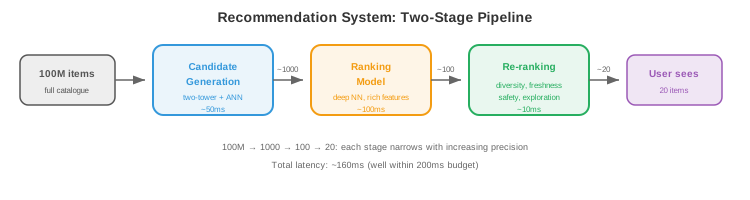
100M items → Candidate Generation (fast, coarse) → 1000 candidates
          → Ranking (slow, precise) → 100 ranked items
          → Re-ranking (business rules) → 20 shown to user
Candidate Generation
- Goal:把 100M items 缩小到约 1000 个候选,必须足够快(<50ms)。
- Two-tower model:将 user 与 item 编码到同一 embedding space。user embedding 表示偏好,item embedding 表示内容特征,score = 两者 dot product。
- Training:在 (user, positive_item, negative_items) 三元组上做 contrastive learning。positive 是用户有过 engagement 的 item;negative 是随机 item + hard negatives(热门但用户没互动过的 item)。
- Serving:预先计算全部 item embeddings。请求到来时计算 user embedding,再用 ANN search(vector database 中的 HNSW)找最近的 1000 个 item embeddings。
Ranking
- Goal:精细打分这 1000 个候选,预算约 100ms。
- Model:deep neural network(MLP 或 transformer),输入丰富 features:user features(demographics、history、context)、item features(content、popularity、freshness)和 cross features(user-item interaction history、contextual relevance)。
- Output:预测 engagement 概率(click、watch 50%+、like、share)。可做多目标加权:\(\text{score} = w_1 \cdot P(\text{click}) + w_2 \cdot P(\text{watch}) + w_3 \cdot P(\text{like})\)。
Re-ranking
- 应用 business rules:diversity(避免同一创作者连刷 5 条)、freshness(提升新内容)、safety(过滤风险内容)、personalised exploration(插入部分低排位但有潜力内容)。
Back-of-Envelope Numbers
- Item embedding index:100M × 256-dim × float16 = 50 GB;HNSW 约有 2x 额外开销,总计约 100 GB。可放在 128 GB RAM 单机,或拆到 4 台 32 GB 机器。
- User embedding computation:每个 user 约 5ms(小型 MLP)。10K QPS 下约需 50 个 model replicas。
- ANN search:100M 向量上用 HNSW 取 top-1000 约 2ms。10K QPS 时每个 index replica 承担约 500 QPS,约需 20 replicas。
- Ranking model:1000 candidates × 每个约 0.1ms = 每请求约 100ms。10K QPS 约需每秒 1000 GPU-seconds,即仅 ranking 约 10 张 A10G。
- 总体基础设施:约 20 个 embedding index replicas + 50 个 user embedding servers + 10 张 ranking GPUs + caching + load balancers。云上成本约 \(50K-\)100K/月。
Cold Start
- New users(无历史):先用 demographics、device/location context 和 popularity-based 推荐;5-10 次交互后切到 personalised model。
- New items(无 engagement data):先用 content-based features(title、description、thumbnail embeddings)。预留 exploration budget,把新 item 展示给一部分用户快速收集数据;boost 期后仍无 engagement 则降权。
- Cold start 是系统问题:feature store 必须优雅处理缺失特征(返回默认值而非报错);model 也应在训练中见过缺失特征(例如对 user history features 做 dropout 模拟新用户)。
Evaluation
- Offline:held-out set 上看 NDCG(Normalized Discounted Cumulative Gain)、recall@K、precision@K。
- Online:A/B test 观察 watch time、DAU、retention。需有周级长周期实验,以捕捉短测看不到的长期留存影响。
2. Search Ranking(如 Google、Bing)
Problem Framing
- Goal:给定 user query,从十亿级 document 语料中返回最相关结果。
- Latency:总计 <500ms(100ms retrieval + 200ms ranking + 100ms rendering + 其余开销)。
Architecture:Query Understanding → Retrieve → Rank
Query Understanding
- 在 retrieval 之前,先处理 raw query 以提高结果质量:
- Spell correction:如 "reccomendation systm" → "recommendation system"。可用 edit-distance model 或在搜索日志 (misspelled, corrected) 样本上训练 sequence-to-sequence model。
- Query expansion:补充相关词提高 recall。如 "Python ML" → "Python machine learning scikit-learn pytorch"。可用 synonym dictionary、word embeddings 或 LLM 生成扩展词。
- Intent classification:识别用户意图。"buy Nike shoes" 属于 transactional(应展示商品页);"How does backpropagation work" 属于 informational(应展示文章);"facebook.com" 属于 navigational(应直接导航)。不同意图应触发不同 retrieval 策略与结果样式。
- Entity recognition:从 query 抽取实体。如 "best restaurants near Times Square" 可识别 location="Times Square"、entity type="restaurants",再路由到 location-aware 搜索链路。
Retrieval
- BM25(传统):基于 inverted index 的 term matching。速度快、关键词检索有效,但缺乏 semantic understanding("dog food" 不一定匹配 "canine nutrition")。
- Dense retrieval:将 query 与 document 编码成 embeddings(如 DPR、ColBERT 这类 bi-encoder),再做 ANN search,可捕捉语义相似("dog food" 匹配 "canine nutrition")。比 BM25 慢,但对自然语言查询更好。
- Hybrid retrieval:组合 BM25 与 dense retrieval。BM25 找精确关键词,dense 找语义匹配,再 merge 去重,兼顾两者优势。
Ranking
- Learning to rank:对每个 (query, document) 对打分。常见三类:
- Pointwise:独立预测每个 document 的 relevance score,简单但忽略相对顺序。
- Pairwise:学习两个 document 谁更相关,经典方案是 LambdaMART(gradient-boosted trees)。
- Listwise:直接优化整个排序列表的指标(如 NDCG),更复杂但效果通常最好。
- Cross-encoder:将
[query, document]联合输入 transformer 输出 relevance score。因能捕捉细粒度交互,精度高于 bi-encoder(后者 query/document 分开编码);但太慢,不能对全量语料使用,通常只对 retrieval 后 top 100-1000 做 re-ranking。
Features
- Query features:query length、language、intent classification(navigational/informational/transactional)。
- Document features:PageRank、freshness、content quality score、domain authority。
- Query-document features:BM25 score、embedding similarity、exact match count、历史日志中该 (query, document) 对的 click-through rate。
3. Ads Click Prediction
Problem Framing
- Goal:预测用户点击 ad 的概率,用于 real-time auction 的出价计算。
- Scale:每秒 100K+ auctions,每次预测预算 10ms 内。
- Revenue impact:click prediction accuracy 提升 0.1%,可能对应数百万级新增收入。
Architecture
- Feature engineering 是 ads system 的核心,典型包括:
- User features:demographics、browsing history、purchase history、device、location、time of day。
- Ad features:creative(image/text)、advertiser、category、historical CTR、bid amount。
- Context features:page content、ad position、device type、connection speed。
- Cross features:user_category × ad_category、user_region × ad_campaign 等交互特征。
- Model:早期多用 logistic regression(简单、快、可解释);现代系统常用 deep learning,如 DLRM(Deep Learning Recommendation Model):categorical features 用 embedding tables,dense features 用 MLP。
- Calibration:预测概率必须可校准(若模型说 P(click)=0.05,实际应接近 5% 点击),因为该概率会直接影响出价。
- Exploration-exploitation:总是展示当前最优 ad 会伤害长期收益(无法发现新 ad 潜力)。可用 Thompson sampling 或 \(\epsilon\)-greedy,让一部分曝光给低确定性 ad 收集数据。
Real-Time Bidding
- 用户打开页面后,<100ms 内完成 ad auction:
- Publisher 向多个 ad exchanges 发送 bid request(含 user 信息与页面上下文)。
- 各 advertiser 的 bidding server 预测其 ad 的 CTR。
- Bid = CTR × value_per_click,出价高者获胜。
- 展示 winning ad;若发生点击,advertiser 付费。
4. Fraud Detection
Problem Framing
- Goal:实时检测欺诈交易(credit card fraud、account takeover、fake reviews)。
- Latency:<100ms(付款链路中必须先放行或拦截)。
- 核心挑战:极端 class imbalance(fraud rate 约 0.1%)。false positives 会误伤正常用户,false negatives 会造成直接损失。
Architecture
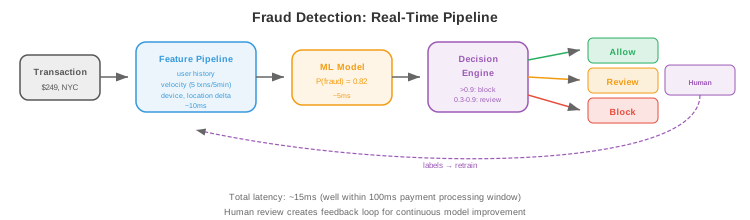
Features
- Transaction features:amount、currency、merchant category、time of day、is_international。
- User features:account age、平均交易金额、近期交易次数、device fingerprint。
- Velocity features(实时来自 streaming pipeline):最近 5 分钟交易数、最近 1 小时商户去重数、与上一笔交易的地理距离。
- Graph features:该 merchant 是否与已知 fraud ring 相连?该 device 是否与被标记账户共享?
Model
- Gradient-boosted trees(XGBoost、LightGBM)是 tabular fraud detection 的常用标准:能处理混合特征类型、可解释(feature importance)且训练快。
- 处理不平衡:可对多数类 undersampling、少数类 oversampling(SMOTE),或在 loss function 使用 class weights。Focal loss(chapter 8)可下调 easy negatives 权重。
- Cost matrix:false positive(拦截正常交易)和 false negative(漏报欺诈)的成本不同。阈值应最小化总期望成本,而不是单纯最大化 accuracy。
Human-in-the-Loop
- 不确定样本(model confidence 在 0.3-0.7)交给人工 reviewer。review 结果再作为 retraining 标签,形成反馈闭环,使 model 随 labeled fraud 样本增加而持续提升。
5. Content Moderation
Problem Framing
- Goal:自动识别并移除平台有害内容(hate speech、violence、misinformation、CSAM)。
- Scale:每天十亿级 posts(text、images、video)。
- 挑战:强上下文依赖(sarcasm、satire、cultural nuance),需平衡表达自由与平台安全。
Architecture
- Multi-modal classification:text、image、video 分别建模,再通过 fusion layer 融合信号。
- Text moderation:fine-tuned language model 把文本分到 harassment、hate speech、misinformation、spam 等类别;multilingual models 覆盖 100+ 语言。
- Image moderation:vision model 检测 explicit content(nudity、violence)、图中文字(OCR + text classifier)和已知有害内容(与已知 CSAM 库做 hash-matching)。
- Video moderation:按时间间隔抽帧,对每帧做 image classifier,并结合音频转写(ASR → text classifier)。
- Policy-as-code:将 moderation policy 写成结构化规则,把 model 输出映射到具体动作:
if text_model.hate_speech_score > 0.9:
    action = "remove"
elif text_model.hate_speech_score > 0.7:
    action = "human_review"
else:
    action = "allow"
- policy 变化频繁(法规更新、社会规范变化)。将 policy 与 model 解耦,可在不 retraining 的情况下快速上线规则调整。
Proactive vs Reactive Moderation
- Proactive(发布前):内容上线前先过 classifiers,高置信违规直接拦截。优点是有害内容不落地,缺点是增加发布 latency 且有 false positives 风险。
- Reactive(发布后):先上线,用户举报后再触发 classifier + human review。优点是发布低延迟,缺点是有害内容在被发现前可见。
- 多数平台混合使用:高危类别走 proactive(如 CSAM,零容忍,发布前阻断);语义复杂类别走 reactive(如 misinformation,需人工判断,举报后复核)。
Hash Matching
- 对已知有害内容(CSAM、恐怖宣传)使用 perceptual hashing:生成对轻微修改(裁剪、缩放、压缩)鲁棒的 hash,与已知有害库(NCMEC hash database、GIFCT shared hash database)比对,命中则可直接下架,无需 classifier。
- PhotoDNA(Microsoft)是 CSAM 检测中的标准 perceptual hash,在许多司法辖区是法律义务,不只是技术选择。
Back-of-Envelope Numbers
- Scale:1B posts/day ≈ 每秒 12K posts。单帖可能需要 text classification(~5ms)、image classification(~20ms)、hash matching(~1ms)。在 12K QPS 下,约需 60 个 text classifiers、240 个 image classifiers、12 个 hash matchers(外加冗余)。
- Human review:若 2% 内容进人工审核,即 20M/day。按每人每天 100 条,需 200K reviewers(这就是自动化准确率的价值:false positives 每降 0.1%,可减少约 1M/day 审核量)。
- Latency budget:proactive moderation 需在发布链路内完成(~500ms)。text(5ms)+ image(20ms)+ hash(1ms)+ overhead 通常可满足;video 是例外,10 分钟视频即便按 1fps 抽帧也要 600 次分类,宜异步处理。
Escalation Workflow
- 自动移除 → 申诉人工复核 → 专家复核(法务、文化专家)→ policy team 处理模糊争议。层级越高,案例量越小但判断更细。
- 反馈给 model:人工审核结论是高质量标签来源。model 与 reviewer 分歧样本应优先进入 active learning,因为它们恰是 model 当前最薄弱的区域。
6. Conversational AI(RAG-Based Chatbot)
Problem Framing
- Goal:基于公司文档构建 chatbot,回答产品相关问题。
- Requirements:答案准确(不 hallucinate)、可引用来源、能处理 follow-up questions、并保持在产品领域内。
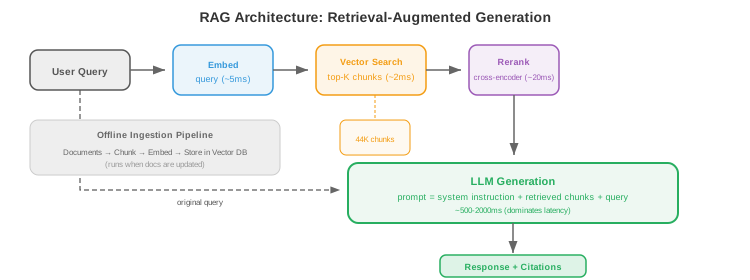
Architecture:Retrieval-Augmented Generation(RAG)
User query → Query Embedding → Vector Search (documentation) → Top-K chunks
                                                                      ↓
User query + Retrieved chunks → LLM → Response (with citations)
Components
- Document ingestion:先对文档 chunking 再 embedding。Chunking strategy 对效果影响很大:
- Fixed-size chunking:每 N tokens(如 500)切一段,并做 M-token overlap(如 50)。简单且长度稳定,但可能切断句子/段落,丢失语义。
- Semantic chunking:按段落或章节边界切,每块语义更完整;缺点是长度不一(有的 100 tokens、有的 800),要求 retrieval system 适配可变长度。
- Recursive chunking:优先按段落切,段落太长再按句子切,句子仍太长再固定长度切;在语义完整性与长度一致性之间更平衡。
- Embedding:用 text encoder(如 E5、BGE、Cohere embed)将 chunk 向量化并存入 vector database。
- Retrieval:将 user query embedding 后在 vector database 搜索最相似的 \(k\) 个 chunks(常用 \(k = 5\)-\(10\)),可选 cross-encoder rerank 提升精度。
- Generation:把 retrieved chunks 作为 context 组装 prompt:
System: You are a helpful assistant. Answer based ONLY on the provided context.
If the answer is not in the context, say "I don't know."

Context:
[chunk 1]
[chunk 2]
...

User: {question}
- Guardrails:防止 LLM 回答域外问题、生成有害内容或与 context 冲突。可通过 input filtering(拒绝 off-topic query)、output filtering(校验回答与 context 一致性)、constitutional prompting(明确拒答规则)实现。
- Conversation memory:保留最近 \(n\) 轮对话并加入 prompt,使 model 能理解追问(如 "What about the pricing?" 需要上一轮具体产品上下文)。
Query Rewriting
- 用户常提出歧义追问,如 "What about the pricing?"(哪个产品的 pricing?)。Query rewriting 结合对话历史生成可独立检索的问题:
- Input:conversation history + "What about the pricing?"
- Rewritten:"What is the pricing for the enterprise plan of Product X?"
- 只有 rewritten query 才应送入 embedding 与 vector search;否则只搜 "pricing" 往往返回无关 chunks。
- Query rewriting 可用一次小型 LLM 调用(~50ms),也可用 fine-tuned sequence-to-sequence model(~5ms)。
Back-of-Envelope Numbers
- Documentation corpus:10K pages,每页平均 2000 tokens,共 20M tokens。按 500 tokens/chunk、50 overlap,约 44K chunks。
- Embedding index:44K × 768-dim × float16 ≈ 65 MB,内存压力很小;即便 10M chunks 也约 15 GB。
- Latency breakdown:query embedding(5ms)+ vector search(2ms)+ cross-encoder rerank(top-50 约 20ms)+ LLM generation(500-2000ms)≈ 600-2100ms。瓶颈在 LLM,可用 streaming 降低感知延迟。
- Cost:按 $3/1M tokens(Claude/GPT-4 API)估算,1000 queries/day、每次约 2K tokens,约 $6/day;若到 1M queries/day,可自托管 7B model(2 张 A10G,约 $50/day),成本可降约 100x。
Evaluation
- Retrieval quality:Recall@K(top-K 是否包含答案)、MRR(Mean Reciprocal Rank)。
- Generation quality:factual accuracy(回答是否与 context 一致)、groundedness(引用是否对应正确 chunks)、answer relevance。
- End-to-end:user satisfaction(thumbs up/down)、升级到人工客服的比例。
7. Large-Scale Image Search
Problem Framing
- Goal:给定一张图,在 1B+ 图像语料中找到视觉相似图片。
- Applications:reverse image search、商品图搜(photo → matching products)、重复图检测。
- Latency:含网络往返在内 <500ms。
Architecture
Embedding Extraction
- Model:预训练 vision encoder(ViT、CLIP image encoder、DINOv2),必要时在具体领域(fashion、e-commerce、medical imaging)fine-tune。
- Training:contrastive learning(chapter 10)。positive pairs 是同图不同视角(或 image + matching text),negative pairs 是随机图像。目标是让相似图 embedding 更近、不同图更远。
Indexing
- Offline:先对 1B 图像全量 embedding,再构建 ANN index。以 HNSW(file 03)为例,建索引通常需数小时,索引驻内存约 128 GB(1B × 512-dim × float16 + 图结构开销)。
- Sharding:将 index 拆到多机,每台持有一个 shard。查询时并行搜所有 shards,再 merge top-K。
- Incremental updates:新增图像(上传、新商品)需持续入索引。HNSW 支持增量插入无需全量重建;Milvus、Pinecone 等 vector database 原生支持该流程。
Serving
- Embedding service:GPU 服务运行 ViT,单图约 20ms,可批处理提升吞吐。
- Search service:ANN index 服务,在 1B 向量上做 top-100 检索约 10ms(HNSW)。
- Caching:对热门查询做结果缓存。做 duplicate detection 时,可先缓存近期上传图 embedding,优先与缓存比对,再决定是否搜索全量 index。
Evaluation
- Precision@K:top-K 结果是否真的相似。
- Recall@K:语料中所有真实相似图,有多少进入 top-K。
- Mean Average Precision(mAP):precision-recall 曲线下面积。
- Human evaluation:针对主观相似性,使用人工标注判断检索结果相关性。
面试作答框架
-
遇到 systems design 题时,可按以下流程:
-
Clarify requirements(2-3 分钟):确认 scale、latency、一致性要求、边界情况。例:"用户量多大?可接受 latency 是多少?故障时怎么处理?"
-
High-level design(5-7 分钟):画出主要组件和交互,从 happy path 开始,优先复用 01-03 文件中的通用模式。
-
Deep dive(15-20 分钟):挑最关键或最难组件深入设计,展示深度。ML system 常见 deep dive 点:model architecture、feature pipeline、serving architecture。
-
Evaluation and monitoring(3-5 分钟):怎么衡量成功?可能出什么问题?如何检测与响应?
-
Iteration(2-3 分钟):如果有更多时间/资源,会优先改进什么?体现你对 tradeoff 与优先级的理解。
-
面试官关注点:是否结构化思考(不盲目跳方案)、是否理解 tradeoff(每个选择都有成本)、是否具备实践感(真的做过系统)、能否清晰沟通设计。