Graph Theory
Graph theory 提供了描述实体关系的数学语言。本文件覆盖 node、edge、adjacency matrix、graph 类型、degree 与连通性、graph Laplacian、spectral graph theory 以及真实世界 graph 应用。我们会在纯计算机科学章节中继续深入 graph。
-
到目前为止,本书里的数据大多处在规则结构上:\(\mathbb{R}^n\) 中的向量(第 1 章)、作为数字网格的矩阵(第 2 章)、像素网格形式的图像(第 8 章)、有序列表形式的序列(第 7 章)。但许多真实系统是不规则的:社交网络没有规则网格结构,分子没有从左到右的天然顺序,路网也不会整齐铺成行列。
-
Graph 是表示这类不规则关系结构的数学工具。一个 graph 捕获实体(node)及其之间的关系(edge)。当数据表示成 graph 后,我们就可以应用文件 1 的 geometric deep learning 原则进行学习。
Node、Edge 与 Adjacency
-
一个 graph \(G = (V, E)\) 由一组 node(或 vertex)\(V = \{v_1, v_2, \ldots, v_n\}\) 和一组连接 node 对的 edge \(E \subseteq V \times V\) 组成。
-
node 表示实体:人、原子、城市、网页、神经元。edge 表示关系:好友关系、化学键、道路、超链接、突触连接。
-
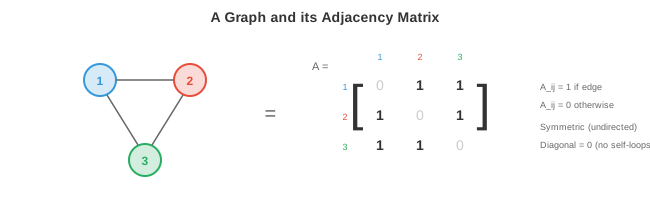
adjacency matrix \(A\) 是 graph 的矩阵表示。对于含 \(n\) 个 node 的 graph,\(A\) 是 \(n \times n\) 矩阵:若从 node \(i\) 到 node \(j\) 有 edge,则 \(A_{ij} = 1\),否则 \(A_{ij} = 0\)。
-
例如,一个三角形 graph(3 个 node,全部互连)的矩阵为:
-
对角线为 0,因为默认 node 不与自己相连(无 self-loop)。adjacency matrix 是第 2 章 Boolean matrix 的直接应用:每个元素都是一个二值关系。
-
adjacency matrix 完整编码了 graph 结构。对 \(A\) 做矩阵运算可揭示 graph 性质:\(A^2_{ij}\) 表示 node \(i\) 与 \(j\) 之间长度为 2 的 path 数量(回忆第 2 章矩阵乘法:每个元素都是对中间 node 的乘积求和)。更一般地,\(A^k_{ij}\) 统计长度为 \(k\) 的 path 数。
-
每个 node 还可携带一个 feature vector \(\mathbf{x}_i \in \mathbb{R}^d\)。在社交网络中,它可以是用户画像;在分子中,它可编码原子类型、电荷等性质。全部 node feature 可写成矩阵 \(X \in \mathbb{R}^{n \times d}\),每一行对应一个 node 的 feature。
-
edge 也可以有 feature:如分子中的键类型、空间 graph 中的距离、知识图谱中的关系类型。edge \((i, j)\) 的 edge feature 记为向量 \(\mathbf{e}_{ij} \in \mathbb{R}^{d_e}\)。
Graph 类型
-
undirected graph 的 edge 对称:若 \(i\) 与 \(j\) 相连,则 \(j\) 与 \(i\) 也相连。其 adjacency matrix 对称:\(A = A^T\)(第 2 章中的对称矩阵)。好友关系和化学键通常是无向的。
-
directed graph(digraph)中的 edge 有方向:从 \(i\) 到 \(j\) 的 edge 不意味着从 \(j\) 到 \(i\) 也有 edge。其 adjacency matrix 通常不对称。Twitter 关注关系、网页链接、引文网络都属于有向 graph。
-
weighted graph 为每条 edge 赋予数值权重。adjacency matrix 不再是二值,而是实数:\(A_{ij} = w_{ij}\)。路网中的距离、脑连接中的相关强度、社交交互频率都可表示为 weighted graph。
-
bipartite graph 由两组互不相交的 node 构成,edge 只存在于两组之间(组内没有 edge)。用户与商品构成典型二部 graph:用户给商品评分,但用户不“评分用户”。二部 graph 的 adjacency matrix 具有分块结构:
-
其中 \(B\) 是这两组 node 之间的 bipartite adjacency matrix。
-
multigraph 允许同一对 node 间存在多条 edge,和/或允许 self-loop。知识图谱通常是 multigraph:两个实体之间可以有多种关系(如“出生于”“居住于”“工作于”)。
-
hypergraph 将 edge 推广为可一次连接两个以上 node。hyperedge 连接一个 node 集合,用于表示高阶关系。比如一篇由 5 位作者合著的论文,就是连接这 5 个作者 node 的一个 hyperedge。
-
complete graph \(K_n\) 在每对 node 之间都有 edge。它是全连接层在 graph 中的对应结构,也是 transformer 所操作的结构(每个 token 都可 attention 到其他 token)。
Degree、Path 与连通性
-
node 的 degree 是连接到它的 edge 数。在 undirected graph 中,node \(i\) 的 degree 为 \(d_i = \sum_j A_{ij}\)。高 degree node 常被称为 hub。
-
degree matrix \(D\) 是对角矩阵,对角元素是各 node degree:\(D_{ii} = d_i\)。这个矩阵在 graph theory 与 GNN 公式中频繁出现。
-
两个 node 之间的 path 是一条由 edge 组成的连接序列。\(i\) 到 \(j\) 的 shortest path(或 geodesic)是 edge 数最少(或 weighted graph 中总权重最小)的 path。Dijkstra algorithm 可在 \(O((|V| + |E|) \log |V|)\) 时间内求最短路径。
-
若任意两 node 间都存在 path,则 graph 是 connected。否则会分成多个 connected component:彼此间没有 edge 的孤立子图。
-
graph 的 diameter 是任意两 node 最短路径中的最大值,衡量 graph 的“展开程度”。社交网络常见小直径现象(“六度分隔”)。
-
cycle 是起点和终点相同的 path。没有 cycle 的 graph 称为 tree。tree 是最简单的 connected graph:\(n\) 个 node 且恰有 \(n-1\) 条 edge。
-
centrality 衡量 node 重要性。degree centrality 就是 degree;betweenness centrality 统计经过该 node 的 shortest path 数;eigenvector centrality 根据邻居的重要性定义 node 重要性,导向特征向量方程 \(A\mathbf{x} = \lambda \mathbf{x}\)(第 2 章)。Google 的 PageRank 是 directed graph 上 eigenvector centrality 的一种变体。
Graph Laplacian
- graph Laplacian 可能是 graph theory 中最重要的矩阵,定义为:
- 其中 \(D\) 是 degree matrix,\(A\) 是 adjacency matrix。对前面的三角形例子:
-
Laplacian 有一些非常关键的性质:
- 它总是 symmetric 且 positive semi-definite(回忆第 2 章:全部特征值都 \(\geq 0\))。对任意向量 \(\mathbf{x}\):
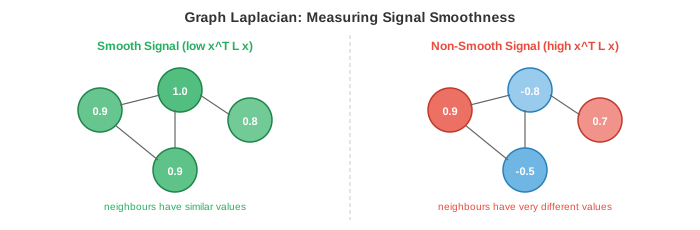
- 这个二次型度量了 graph 上信号 $\mathbf{x}$ 在 edge 两端的变化程度。若相邻 node 取值相近,则 $\mathbf{x}^T L \mathbf{x}$ 小;若变化剧烈,则该值大。也就是说,Laplacian 度量的是 graph 上信号的 **smoothness**。

- 最小特征值总是 0,对应特征向量 $\mathbf{1} = [1, 1, \ldots, 1]^T$(常数信号没有变化)。零特征值的个数等于 connected component 的个数。

- 第二小特征值 $\lambda_2$ 称为 **algebraic connectivity**(Fiedler value)。它衡量 graph 连通得有多紧密:$\lambda_2 = 0$ 表示 graph 不连通,$\lambda_2$ 越大表示连通越紧密。
- normalised Laplacian 会按 degree 做归一化:
- 这种归一化保证 Laplacian 的性质不依赖 node degree 的绝对尺度。项 \(D^{-1/2} A D^{-1/2}\) 被称为 symmetrically normalised adjacency,它会直接出现在 GCN 公式中(文件 3)。
Spectral Graph Theory
-
graph Laplacian 的特征值与特征向量定义了 graph 的 spectrum,它们可视为 Fourier transform 在 graph 上的对应物。
-
在经典信号处理中,Fourier transform 将信号分解为频率分量(正弦和余弦)。在 graph 上,Laplacian 的特征向量扮演这些频率基的角色。低特征值对应的特征向量在 graph 上变化慢(低频、平滑);高特征值对应的特征向量变化快(高频、振荡)。
-
graph 上信号 \(\mathbf{x}\) 的 Graph Fourier Transform(GFT) 为:
-
其中 \(U\) 是 Laplacian 特征向量矩阵(回忆第 2 章特征分解:\(L = U \Lambda U^T\))。逆变换为 \(\mathbf{x} = U \hat{\mathbf{x}}\)。
-
频谱域中的 graph convolution 是频域逐点乘法,这与第 8 章中的经典卷积定理一致(空间域卷积对应 Fourier 域乘法):
-
滤波器 \(\hat{g}_\theta\) 是特征值的可学习函数。这是 spectral GNN 的基础,而我们会在文件 3 将其简化为实用的 GCN。
-
计算瓶颈在于对 \(L\) 做特征分解:对含 \(n\) 个 node 的 graph,代价是 \(O(n^3)\)。对大规模 graph(百万级 node)不现实。多项式近似(如 Chebyshev polynomial)可完全避免特征分解,而这种近似正是通向 GCN 的关键步骤。
Community Detection
-
许多真实 graph 都有 community structure:簇内连接稠密、簇间连接稀疏。社交网络中的好友圈、生物网络中的功能模块、引文网络中的研究领域都属于此类。
-
spectral clustering 使用 Laplacian 特征向量来发现 community。思路是:用 \(L\) 最小的 \(k\) 个非平凡特征向量对每个 node 做 embedding,然后在该 embedding 空间里做 k-means(第 6 章)。同一 community 的 node 会在该空间中更接近。
-
其有效性来自 Fiedler vector(\(\lambda_2\) 对应特征向量)能自然把 graph 分为两组:值为正的一组与值为负的一组,切分通常经过最稀疏连接处。更高阶特征向量可进一步细分更多 group。
-
modularity \(Q\) 衡量 community 划分质量。它比较“簇内 edge 数”与“随机 graph 下期望簇内 edge 数”:
- 其中 \(c_i\) 是 node \(i\) 的 community 标签,\(\delta\) 在两 node 属于同一 community 时取 1。\(Q\) 范围大致在 \(-0.5\) 到 \(1\),越高表示 community 结构越显著。
真实世界中的 Graph
-
社交网络:node 是人,edge 是好友或交互。Facebook 拥有数十亿 node 与数千亿 edge。这类 graph 通常稀疏(每人只有几百个好友,而非几十亿),具有 small-world 性质(平均路径短)并呈 heavy-tail degree 分布(少量 hub 拥有极高连接数)。
-
分子 graph:node 是原子,edge 是化学键。每个原子有 feature(元素类型、电荷、杂化态等),每条键也有 feature(单键、双键、三键、芳香键)。分子 graph 规模虽小(几十到几百 node),但结构高度精细。根据 graph 结构预测分子性质是 GNN 的核心应用之一。
-
知识图谱:node 是实体(人、地点、概念),edge 是有类型关系(如“出生于”“首都是”“实例是”)。知识图谱支撑搜索引擎、推荐系统和问答系统。它们通常是大规模 directed multigraph,包含数百万实体和数十亿关系。
-
引文网络:node 是论文,edge 是引用关系(有向)。聚类可揭示研究社区。node feature 可包括标题、摘要与发表年份。
-
蛋白质互作网络:node 是蛋白质,edge 表示物理互作或功能关联。理解这些 graph 有助于识别药物靶点和疾病机制。
-
路网与交通网络:node 是路口,edge 是带距离/时间权重的路段。最短路径算法是导航系统核心。自动驾驶中的运动预测(第 11 章)也会将 agent 交互建模为 graph。
Coding Tasks(使用 CoLab 或 notebook)
-
用 adjacency matrix 构建一个小 graph,并计算基本性质:每个 node 的 degree、长度为 2 的 path 数量,以及 graph 是否 connected。
import jax.numpy as jnp # A simple graph: 5 nodes # 0-1, 0-2, 1-2, 2-3, 3-4 A = jnp.array([[0, 1, 1, 0, 0], [1, 0, 1, 0, 0], [1, 1, 0, 1, 0], [0, 0, 1, 0, 1], [0, 0, 0, 1, 0]], dtype=float) # Degree degrees = A.sum(axis=1) print(f"Degrees: {degrees}") # Paths of length 2 A2 = A @ A print(f"Paths of length 2 (node 0 to 3): {int(A2[0, 3])}") # Connected? Check if A^(n-1) has all nonzero entries An = jnp.linalg.matrix_power(A + jnp.eye(5), 4) # (A+I)^4 for reachability connected = jnp.all(An > 0) print(f"Connected: {connected}") -
计算 graph Laplacian 及其 eigenvalue。验证最小 eigenvalue 是否为 0,且对应 eigenvector 是否为常量向量。
import jax.numpy as jnp A = jnp.array([[0, 1, 1, 0, 0], [1, 0, 1, 0, 0], [1, 1, 0, 1, 0], [0, 0, 1, 0, 1], [0, 0, 0, 1, 0]], dtype=float) D = jnp.diag(A.sum(axis=1)) L = D - A eigenvalues, eigenvectors = jnp.linalg.eigh(L) print(f"Eigenvalues: {eigenvalues}") print(f"Smallest eigenvector: {eigenvectors[:, 0]}") print(f"Fiedler value (algebraic connectivity): {eigenvalues[1]:.4f}") # Verify: x^T L x measures smoothness x = jnp.array([1.0, 1.0, 1.0, -1.0, -1.0]) # two groups smoothness = x @ L @ x print(f"Smoothness of two-group signal: {smoothness:.2f}") -
在一个包含两个 community 的 graph 上执行 spectral clustering。使用 Fiedler vector 对 node 做 embedding,并按符号分组。
import jax.numpy as jnp
import matplotlib.pyplot as plt

# Two communities of 5 nodes each, weakly connected
A = jnp.zeros((10, 10))
# Community 1: nodes 0-4 (dense)
for i in range(5):
    for j in range(i+1, 5):
        A = A.at[i, j].set(1).at[j, i].set(1)
# Community 2: nodes 5-9 (dense)
for i in range(5, 10):
    for j in range(i+1, 10):
        A = A.at[i, j].set(1).at[j, i].set(1)
# One bridge edge
A = A.at[2, 7].set(1).at[7, 2].set(1)

D = jnp.diag(A.sum(axis=1))
L = D - A
eigenvalues, eigenvectors = jnp.linalg.eigh(L)

# Fiedler vector (2nd smallest eigenvalue)
fiedler = eigenvectors[:, 1]
communities = (fiedler > 0).astype(int)

print(f"Fiedler vector: {fiedler}")
print(f"Clusters: {communities}")

plt.bar(range(10), fiedler, color=["#3498db" if c == 0 else "#e74c3c" for c in communities])
plt.xlabel("Node"); plt.ylabel("Fiedler vector value")
plt.title("Spectral Clustering via Fiedler Vector")
plt.show()