Graph Neural Networks
Graph neural network 通过 connected node 间的 message passing 从 graph 结构数据中学习。本文件覆盖 message-passing 框架、GCN、GraphSAGE、GIN、over-smoothing、graph pooling 以及 node/edge/graph 级任务;这些是支撑分子性质预测、社交网络分析和推荐系统的核心架构。
-
在前两个文件中,我们已经建立了数学基础:geometric deep learning(文件 1)告诉我们要利用 symmetry,graph theory(文件 2)提供了 node、edge 与 adjacency 的语言。现在我们开始构建可直接在 graph 上运行的神经网络。
-
核心挑战在于:graph 数据是不规则的。不同于图像(固定 grid)或序列(固定顺序),graph 的 node 数可变、连接关系可变,也没有规范的 node 顺序。因此 graph 网络必须在处理这些变化的同时保持 permutation-equivariant(重标号 node 不应改变输出)。
Message-Passing 框架
-
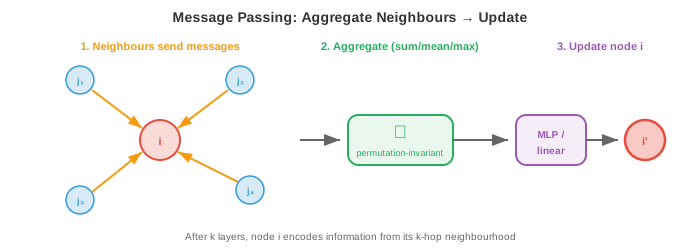
几乎所有 GNN 都遵循同一套范式:message passing(也叫 neighbourhood aggregation)。思想很简洁:每个 node 通过汇聚邻居信息来更新自己的表示。
-
在第 \(l\) 层,每个 node \(i\) 做三件事:
- Message:每个邻居 \(j\) 基于当前 feature 计算发往 \(i\) 的消息 \(\mathbf{m}_{j \to i}\)。
- Aggregate:node \(i\) 将所有入站消息用 permutation-invariant 函数聚合(sum、mean 或 max)。
- Update:node \(i\) 将聚合结果与自身 feature 结合,生成新的表示。
-
形式化写作:
- 其中,\(\mathcal{N}(i)\) 是 node \(i\) 的邻居集合,\(\bigoplus\) 是 permutation-invariant 聚合(sum、mean、max),\(\phi\) 是 message 函数,\(\psi\) 是 update 函数,\(\mathbf{e}_{ij}\) 是可选的 edge feature。
-
聚合算子 \(\bigoplus\) 必须是 permutation-invariant(邻居处理顺序不影响结果),才能保证整体函数是 permutation-equivariant。这正是文件 1 中 symmetry 原则的直接实现。
-
经过 \(k\) 层 message passing 后,每个 node 的表示会编码其 \(k\)-hop neighbourhood 信息:即在 \(k\) 条 edge 内可达的所有 node。第 1 层看到一跳邻居,第 2 层看到邻居的邻居,以此类推。局部信息因此逐步传播并形成全局理解。
-
GNN 的感受野会随深度增长,这与 CNN 在第 8 章中的感受野扩展类似。但不同的是,GNN 感受野的形状由 graph topology 决定,因此不同 node 会不同。
Graph Convolutional Network(GCN)
-
GCN(Kipf & Welling, 2017)是奠基性的 GNN 架构。它把文件 2 的 spectral graph convolution 简化成优雅且高效的公式。
-
从谱卷积 \(g_\theta \star \mathbf{x} = U \, \text{diag}(\hat{g}_\theta) \, U^T \mathbf{x}\) 出发,Kipf 与 Welling 用一阶 Chebyshev polynomial 近似谱滤波器,从而避免显式特征分解。化简后层更新为:
-
其中:
- \(H^{(l)} \in \mathbb{R}^{n \times d}\) is the matrix of node features at layer \(l\)
- \(W^{(l)} \in \mathbb{R}^{d \times d'}\) is a learnable weight matrix
- \(\hat{A} = \tilde{D}^{-1/2} \tilde{A} \tilde{D}^{-1/2}\) is the symmetrically normalised adjacency matrix with self-loops
- \(\tilde{A} = A + I\) adds self-loops (so each node also receives its own message)
- \(\tilde{D}\) is the degree matrix of \(\tilde{A}\)
- \(\sigma\) is a nonlinear activation (ReLU, as in chapter 6)
-
矩阵乘法 \(\hat{A} H^{(l)}\) 对应聚合步骤:对每个 node 计算邻居 feature 的加权平均(通过 self-loop 同时包含自己)。权重矩阵 \(W^{(l)}\) 是可学习变换,并在所有 node 间共享。激活函数提供非线性。
-
该结构非常简洁:一次矩阵乘法 + 一次可学习线性变换 + 激活。整个 GCN 层几乎可一行代码实现。\(\tilde{D}^{-1/2}\) 的归一化可防止高 degree node 主导聚合:邻居很多的 node 会被缩放。
-
在 message-passing 框架下,GCN 对应:
- Message: \(\phi(\mathbf{h}_j) = \mathbf{h}_j\) (just send your features)
- Aggregation: normalised sum (weighted by degree)
- Update: linear transformation + activation
GraphSAGE
-
GCN 是 transductive 的:训练时需要整张 graph,且难以直接处理未见过的新 node。比如社交网络新增用户时,GCN 往往需要在全图重训。GraphSAGE(Hamilton et al., 2017)用 inductive 方法解决了这个问题。
-
核心思路是 neighbourhood sampling:不使用所有邻居,而是采样固定大小子集。这样计算不再依赖完整 graph 规模,也能泛化到未见 node 或新 graph。
-
The GraphSAGE update for node \(i\):
-
其中 \(\mathcal{S}(i)\) 是邻居的采样子集(如从 500 个邻居中随机采样 10 个)。CONCAT 显式区分了 node 自身 feature 与邻域聚合 feature,使网络可分别学习“self”与“neighbourhood”的变换。
-
GraphSAGE 支持多种聚合函数:
- Mean: \(\text{AGG} = \frac{1}{|\mathcal{S}|} \sum_{j \in \mathcal{S}} \mathbf{h}_j\) (simple, effective)
- LSTM: feed the sampled neighbours through an LSTM (but this introduces an ordering dependency, somewhat violating permutation invariance)
- Pool: \(\text{AGG} = \max(\{\sigma(W_{\text{pool}} \mathbf{h}_j + \mathbf{b})\})\) (nonlinear transform then max)
-
采样策略让 GraphSAGE 可扩展到超大 graph。训练采用 node mini-batch:对每个目标 node,在第 1 层采样 \(k_1\) 个邻居,再对这些邻居在第 2 层各采样 \(k_2\) 个。若 \(k_1 = k_2 = 10\) 且有 2 层,则每个目标 node 的计算树最多 \(10 \times 10 = 100\) 个 node,与全图规模无关。
Graph Isomorphism Network(GIN)
-
不同 GNN 架构的 expressive power 不同,即区分结构差异 graph 的能力不同。GCN 和 GraphSAGE 虽然实用,但在可区分结构上有理论上限。
-
衡量 GNN 表达力的经典理论工具是 Weisfeiler-Lehman(WL)test,用于测试 graph isomorphism(两个 graph 是否结构同构)。WL test 通过将每个 node 的标签与其邻居标签 multiset 一起 hash,迭代细化 node 标签。
-
GIN(Xu et al., 2019)被设计为与 WL test 同等级表达力,因此在 message-passing 框架内达到很强能力。关键点是:聚合函数对 multiset 必须是 injective(不同邻居 multiset 应得到不同聚合值)。
-
Sum 聚合在 multiset 上可做到 injective(例如标量上 \(\{1,1,2\}\) 与 \(\{1,3\}\) 都是 4,但在足够维 feature vector 空间里,不同 multiset 的和通常可区分)。Mean 与 max 不是 injective:mean 无法区分 \(\{1,1\}\) 和 \(\{2,2\}\),max 无法区分 \(\{1,2,3\}\) 和 \(\{1,1,3\}\)。
-
The GIN update is:
- 其中 \(\epsilon\) 是可学习标量(或固定为 0),MLP 提供非线性且 injective 的映射。sum 聚合保留了 multiset 结构,MLP 则可学习区分不同聚合结果。
Over-Smoothing
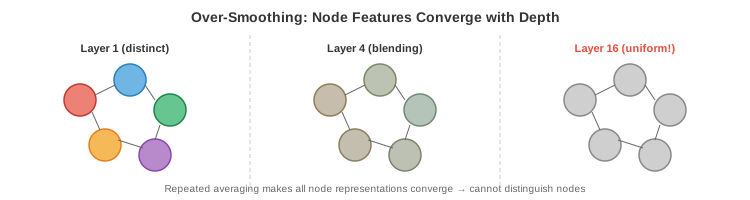
- GNN 的主要挑战之一是 over-smoothing:层数加深后,不同 node 表示逐渐收敛到几乎相同,丧失区分能力。
-
其机制直观:每层都会把 node feature 与邻居做平均。多轮平均后,每个 node 都与同一 connected component 中几乎所有 node 混合,表示趋于统一平均值,类似图像反复模糊后趋于纯色。
-
形式上,反复作用 normalised adjacency \(\hat{A}\) 会收敛到 rank-1 矩阵(每一行都与随机游走的平稳分布成比例)。这与第 2 章 power iteration 收敛到主特征向量是同一类现象。
-
over-smoothing 使 GNN 往往只能用浅层(通常 2-4 层),不同于 CNN/transformer 可受益于数十或数百层。这意味着每个 node 可见范围有限,对长程依赖任务不利。
-
常见缓解方案包括:
- Residual connections (from ResNets, chapter 8): \(\mathbf{h}_i^{(l+1)} = \mathbf{h}_i^{(l+1)} + \mathbf{h}_i^{(l)}\), preserving information from earlier layers.
- Jumping knowledge: concatenate or attention-pool representations from all layers, not just the last.
- DropEdge: randomly remove edges during training, slowing the information spread.
- Graph Transformers (file 4): bypass the local message-passing bottleneck with global attention.
Graph Pooling
-
对于 graph-level task(例如预测整个分子的毒性),我们需要把所有 node 表示压缩成单个 graph-level 向量。这就是 graph pooling,可类比 CNN(第 8 章)的 global average pooling。
-
最简单方法是 readout:对所有 node feature 集合使用 permutation-invariant 函数:
-
这本质上是文件 1 的 DeepSets 聚合,应用在 GNN 最后一层之后。sum 会保留规模信息(100 个 node 的 graph 通常比 10 个 node 的 sum 更大),mean 则会对规模归一化。
-
hierarchical pooling 会逐步 coarsen graph,类似 CNN 逐步下采样图像。每个层级都会把一组 node 合并成“supernode”:
-
DiffPool (Differentiable Pooling) learns a soft assignment matrix \(S^{(l)} \in \mathbb{R}^{n_l \times n_{l+1}}\) that assigns each node to a cluster:
-
assignment 矩阵由另一个 GNN 预测,因此聚类过程可端到端可微。于是得到层级结构:原始 graph → 更少 node 的 coarsened graph → 更粗 graph → 单个 node(即 graph 表示)。
-
TopKPool 更简单:为每个 node 学一个标量分数,保留 top-\(k\),丢弃其余。这是硬选择(而非 soft assignment),计算开销也低于 DiffPool。
Heterogeneous Graph
-
前面介绍的 GNN 都默认 homogeneous graph:单一 node 类型、单一 edge 类型。但真实 graph 多为 heterogeneous:多 node 类型 + 多 edge 类型。知识图谱中有人、组织、地点等 node,边类型有“works at”“born in”“located in”;推荐系统中有 user 与 item node,边类型有“purchased”“viewed”“rated”。
-
heterogeneous graph 具有 schema(或 metagraph),定义允许的 node 类型与 edge 类型。每种 edge 类型连接特定 source 类型与 target 类型。例如“works at”连接 Person → Organisation。
-
Relational GCN(R-GCN)(Schlichtkrull et al., 2018)通过“每种 edge 类型单独一个权重矩阵”处理 heterogeneous edge:
-
其中 \(\mathcal{R}\) 是 edge 类型集合,\(\mathcal{N}_r(i)\) 是通过关系 \(r\) 与 node \(i\) 相连的邻居集合,\(W_r\) 是关系 \(r\) 专用权重矩阵。自连接项 \(W_0\) 单独处理 node 自身 feature。
-
问题在于:关系类型多时参数会爆炸(每种关系一个 \(d \times d\) 矩阵)。R-GCN 用 basis decomposition 缓解:\(W_r = \sum_{b=1}^{B} a_{rb} V_b\),其中 \(V_b\) 是共享 basis 矩阵,\(a_{rb}\) 是关系相关标量系数。这类似第 2 章低秩分解:关系矩阵位于低维子空间。
-
Heterogeneous Graph Transformer(HGT)(Hu et al., 2020)把 attention 机制用于 heterogeneous graph。关键是 attention 应同时依赖 node 类型与两者之间 edge 类型。HGT 为 query、key、value 使用类型专属投影:
-
其中 \(\tau(i)\) 是 node \(i\) 的类型,\(\phi(i,j)\) 是两者间 edge 类型。这样模型就能对不同关系类型分配不同 attention:例如 paper attention 到 author 时,与 attention 到 reference 时应使用不同权重。
-
metapath-based 方法在 schema 上定义有语义的路径(如 Author → Paper → Author 表示共作者关系),并沿路径聚合信息。HAN(Heterogeneous Attention Network)做两级 attention:先在每条 metapath 内部(哪些邻居重要),再在不同 metapath 之间(哪些关系模式更重要)。
Link Prediction 与知识图谱补全
-
link prediction 要回答:在已有 edge 的基础上,哪些缺失 edge 最可能存在?它是知识图谱补全(补全事实)、推荐(预测用户偏好)、社交分析(预测未来好友关系)的核心任务。
-
embedding-based 方法为每个实体学习向量、为每种关系学习变换,再根据“实体与关系是否匹配”给候选 edge 打分:
-
TransE models relations as translations in embedding space: if \((h, r, t)\) is a valid triple (head entity, relation, tail entity), then \(\mathbf{h} + \mathbf{r} \approx \mathbf{t}\). The scoring function is \(f(h, r, t) = -\|\mathbf{h} + \mathbf{r} - \mathbf{t}\|\). Intuitively, the relation vector "moves" the head entity to the tail entity in embedding space.
-
RotatE models relations as rotations in complex space: \(\mathbf{t} = \mathbf{h} \circ \mathbf{r}\), where \(\circ\) is element-wise complex multiplication and \(|\mathbf{r}_i| = 1\) (unit complex numbers are rotations). This can model symmetry, antisymmetry, inversion, and composition patterns that TransE cannot.
-
ComplEx uses complex-valued embeddings with a Hermitian dot product, enabling it to model asymmetric relations (if A is the boss of B, B is not the boss of A).
-
基于 GNN 的 link prediction 会先用 message passing 得到 node embedding,再用两端 embedding 对 edge 打分。它结合了 GNN 的结构推理能力和 embedding 方法的关系建模能力;GNN 编码器还能捕获单点 embedding 难以表达的 multi-hop 邻域结构。
任务类型
-
GNN 主要解决三类任务:
-
Node-level task:为每个 node 预测属性。例子包括:社交网络用户分类(bot/human)、蛋白质互作网络中的蛋白功能预测、半监督 node 分类(少量有标签 node 推断其余)。输出通常是 node embedding \(\mathbf{h}_i^{(L)}\) 再接分类器。
-
Edge-level task:为每条 edge 预测属性,或预测 edge 是否存在。例子包括:link prediction(两用户是否会成为好友)、知识图谱补全(某关系是否成立)、药物-药物相互作用预测。输出常由端点 embedding 组合得到:\(\hat{y}_{ij} = f(\mathbf{h}_i, \mathbf{h}_j)\),其中 \(f\) 可为 dot product、concatenate + MLP 等。
-
Graph-level task:为整张 graph 预测属性。例子包括:分子性质预测(该分子是否有毒)、graph 分类(该社交网络是否 bot 网络)、graph 生成(设计目标性质分子)。输出通过 graph pooling 得到 \(\mathbf{h}_G\),再做分类或回归。
Coding Tasks(使用 CoLab 或 notebook)
-
用 normalised adjacency matrix 从零实现单层 GCN。将其应用到一个小 graph,观察 node feature 如何被平滑。
import jax import jax.numpy as jnp # Graph: 5 nodes, simple chain with a branch A = jnp.array([[0, 1, 0, 0, 0], [1, 0, 1, 0, 0], [0, 1, 0, 1, 1], [0, 0, 1, 0, 0], [0, 0, 1, 0, 0]], dtype=float) # Add self-loops A_hat = A + jnp.eye(5) D_hat = jnp.diag(A_hat.sum(axis=1)) D_inv_sqrt = jnp.diag(1.0 / jnp.sqrt(A_hat.sum(axis=1))) A_norm = D_inv_sqrt @ A_hat @ D_inv_sqrt # Node features: one-hot identity H = jnp.eye(5) # Weight matrix (random initialisation) rng = jax.random.PRNGKey(0) W = jax.random.normal(rng, (5, 3)) * 0.5 # GCN layer: H' = ReLU(A_norm @ H @ W) H_new = jax.nn.relu(A_norm @ H @ W) print("Original features (one-hot):") print(H) print("\nAfter GCN layer:") print(jnp.round(H_new, 3)) print("\nNotice: connected nodes now have similar representations") -
实现 sum aggregation(GIN 风格)的 message passing,并与 mean aggregation(GCN 风格)比较。展示 sum 能区分而 mean 不能区分的 multiset。
import jax.numpy as jnp # Two different neighbourhood multisets that have the same mean # Node A: neighbours have features [1, 1, 1, 1] (four neighbours, all 1) # Node B: neighbours have features [2, 2] (two neighbours, all 2) neighbours_A = jnp.array([[1.0], [1.0], [1.0], [1.0]]) neighbours_B = jnp.array([[2.0], [2.0]]) # Mean aggregation mean_A = neighbours_A.mean(axis=0) mean_B = neighbours_B.mean(axis=0) print(f"Mean A: {mean_A}, Mean B: {mean_B}, Same: {jnp.allclose(mean_A, mean_B)}") # Sum aggregation sum_A = neighbours_A.sum(axis=0) sum_B = neighbours_B.sum(axis=0) print(f"Sum A: {sum_A}, Sum B: {sum_B}, Same: {jnp.allclose(sum_A, sum_B)}") print("\nSum distinguishes these multisets; mean does not!") -
演示 over-smoothing。反复应用 normalised adjacency,观察 node feature 逐步收敛。
import jax.numpy as jnp
import matplotlib.pyplot as plt

# Random graph
A = jnp.array([[0,1,1,0,0,0],
               [1,0,1,0,0,0],
               [1,1,0,1,0,0],
               [0,0,1,0,1,1],
               [0,0,0,1,0,1],
               [0,0,0,1,1,0]], dtype=float)

A_hat = A + jnp.eye(6)
D_inv_sqrt = jnp.diag(1.0 / jnp.sqrt(A_hat.sum(axis=1)))
A_norm = D_inv_sqrt @ A_hat @ D_inv_sqrt

# Initial features: distinct per node
H = jnp.array([[1,0], [0,1], [1,1], [-1,0], [0,-1], [-1,-1]], dtype=float)

distances = []
for k in range(20):
    H = A_norm @ H
    # Measure how distinct the features are (std across nodes)
    spread = jnp.std(H, axis=0).mean()
    distances.append(float(spread))

plt.plot(distances, "o-")
plt.xlabel("Number of message-passing rounds")
plt.ylabel("Feature spread (std across nodes)")
plt.title("Over-Smoothing: Features Converge with Depth")
plt.show()